
Business
Popular baby monitoring company Owlet warns parents after child dies from loose camera cable
By Marcus Chen
Advertisement · Why this ad?
Marcus manages the day-to-day editorial workflow across all brands, coordinating coverage assignments and ensuring editorial standards are met. He previously served as city editor at the Pioneer Press and holds a degree in Political Science from Carleton College.
More from Marcus →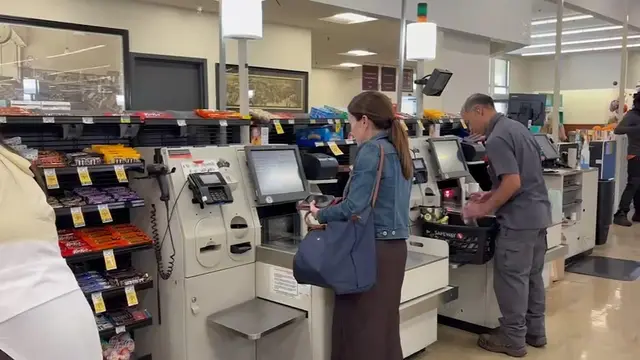
Proposal would assign one employee for every three stations By Lyanne Melendez Saturday, November 14, 2026 6:38AM A new San Francisco proposal would require one employee per three delf-checkout stations to curb theft and preserve retail jobs.
A proposal before San Francisco officials would require grocery and retail stores to provide one employee for every three self-checkout stations, a measure supporters say would improve customer service, reduce theft and preserve retail jobs.
The proposal, introduced by San Francisco Board of Supervisors President Rafael Mandelman, comes as self-checkout stations have become increasingly common in grocery stores and pharmacies.
At one Safeway store in San Francisco, more than 10 self-checkout stations were operating with a single attendant responsible for assisting customers, resolving technical issues, voiding transactions and monitoring activity.
During a visit, security personnel intervened in a confrontation involving a customer.
Supporters of the proposal argue that one worker monitoring numerous stations creates an unreasonable workload.
"We want to make sure that customers have a good experience so we're not banning self-checkout here, we're just eliminating that amount that each worker is responsible to three," said James Araby of United Food and Commercial Workers Local 5.
The proposal was prompted in part by concerns over declining retail employment.
A report from the U.S. Bureau of Labor Statistics found the number of retail cashiers has fallen since 2019 and projects a 6% decline nationwide over the next decade, resulting in the loss of approximately 200,000 jobs.
"The reduction of clerks in these stores is not something we can stop but we would like to save some of these jobs," Mandelman said.
Efforts to regulate self-checkout systems have been debated at both the state and local levels.
Several proposals in Sacramento failed to advance, leaving local governments to consider their own regulations.
San Jose is considering a similar measure, while four California cities have already adopted self-checkout rules.
Business groups are pushing back, arguing the proposal could increase operating costs for stores that already operate on narrow margins.
"When you start to change the math there, its going to have to come from somewhere and unfortunately that's probably going to be higher prices on grocery store shelves or as we've seen in other cities like Long Beach grocers will just close self-checkout all together," said Nate Rose of the California Grocers Association.
According to opponents, 10 stores in Long Beach removed self-checkout stations after that city's ordinance took effect in 2025, citing concerns about how the law was being interpreted and enforced. Araby disputed the argument that the proposal would force stores to eliminate self-checkout.
"You're telling me you can't pay one person, one additional person upfront?" he said.
Apple employee charged with murder after crashing into car at nearly 100 mph killing toddler Level 2 storm to bring rain, dangerous surf to Bay Area and more than a foot of snow to the Sierra EXCLUSIVE: Teen surfer helps save person after jump from Golden Gate Bridge "I think what they're trying to do is create unnecessary demand for this by saying we're not going to have it at all and blame the union," Araby added.
Customers are also divided on the proposal.
"Too much in their business. I don't care what they do. I feel like there are other priorities in the city that should have regulations, should have this attention as opposed to what happens at Whole Foods," said San Francisco resident Tony Ramos.
Another resident, Elyze Stewart, said she supports the idea if it helps reduce theft and create jobs.
"If it makes it easier to not have stealing going on to have two people working, then I would support it. I mean jobs for as many people as possible is what I would say," Stewart said.
In addition to staffing requirements, Mandelman's proposal would limit self-checkout transactions to 15 items or fewer.
"More eyes in the store is a good thing and the impacts of retail theft are not just on the retailer itself, it's also on the community and on the surrounding businesses," Mandelman said.
The San Francisco Chamber of Commerce has questioned whether the proposal is necessary, arguing that theft at self-checkout stations has declined and noting that store employees often are prohibited from confronting suspected shoplifters.
"Typically, the self-checkout has cameras and I think we've all been through an experience even if you're not putting an item in the right place, that there is going to have to be a human that trouble shoots," said David Harrison, Director of Public Policy for the SF Chamber of Commerce.
Some retailers have already implemented additional anti-theft measures.
At one San Francisco grocery store, customers were required to scan a barcode from their receipt to open electronic exit gates, while security personnel conducted occasional receipt checks before shoppers left the store.
If approved, enforcement of the self-checkout regulations would fall to the Office of Labor Standards Enforcement and the San Francisco City Attorney's Office.
Report a correction or typo
Copyright © 2026 KGO-TV. All Rights Reserved.
Apple employee charged with murder after crashing into car at nearly 100 mph killing toddler Level 2 storm to bring rain, dangerous surf to Bay Area and more than a foot of snow to the Sierra EXCLUSIVE: Teen surfer helps save person after jump from Golden Gate Bridge AccuWeather Forecast: Scattered showers and breezy conditions overnight Nvidia CEO Jensen Huang resigns after 2nd affair with subordinate revealed in report
Belvedere, California
Business
Saturday, November 14, 2026
4 min
By Marcus Chen

By Marcus Chen

By Katherine Langford

By Marcus Chen